Written By –
Soumyadeep Das
Student, Guitarist & Financial Advisor
Diploma On IT Application, Webel
At First, I will tell you about Guitar –
Firstly, The guitar is a fretted musical instrument that typically has six strings. It is usually held flat against the player’s body and played by strumming or plucking the strings with the dominant hand, while simultaneously pressing selected strings against frets with the fingers of the opposite hand.
A ideal guitar –
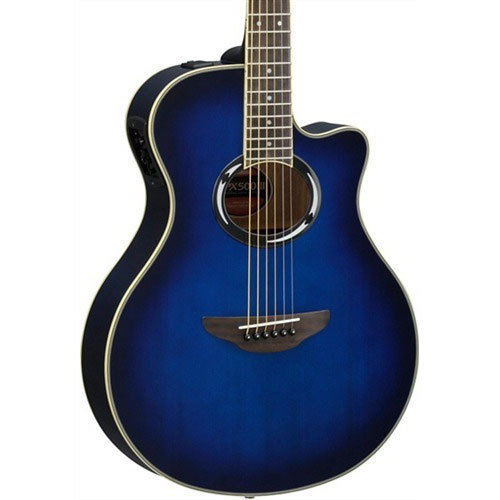
There are 3 main types of guitar: acoustic, electric and bass. But there are some important variations within those groups that some people classify as different types of guitar entirely.Let’s take a closer look….Types Of Guitar #1 – Acoustic GuitarsThis is the type of guitar most people are familiar with.Acoustic guitars have hollow bodies which amplify the sound of the strings acoustically. They are usually made of wood, have six strings and look something like this:types of guitar
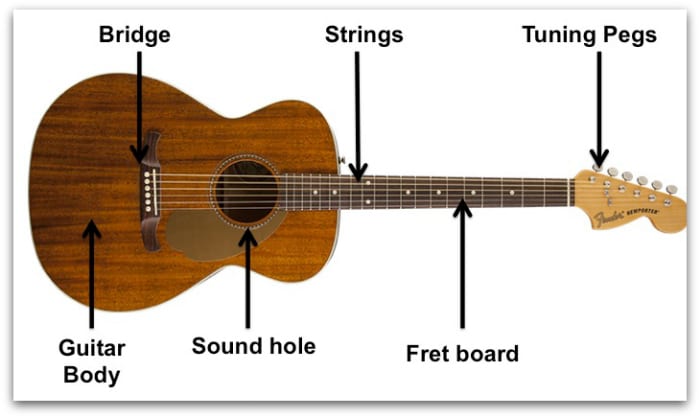
There are a number of different body shapes of acoustic guitars. (There are many different sizes too.)Some acoustics are symmetrical (like the one in the picture above) and others have a ‘cut-away‘, which means that a bit of the body of the guitar has been cut away to allow us easy access to the higher frets.‘Dreadnoughts‘ and ‘Jumbos‘ have larger bodies which give off a big booming sound, whereas ‘Parlour’ and ‘Auditorium’ guitars have a quieter and more articulate tone.For every type, there’s a range of sizes from ‘half size‘ to ‘three quarter size‘ to ‘full size‘. depending on the size of the guitarist’s body.
Acoustic string types
Some acoustics have steel strings which are ideal for folk, rock, blues & country.
Others have nylon strings which are better for classical and flamenco guitar.

While most acoustic guitars have six strings, there are some that have 12 strings.
Twelve string guitars are tuned the same as six string guitars, except each string is doubled, producing a lush harp-like sound.
While most acoustic guitars are made of wood, some, such as the famous National Guitar are made of metal!

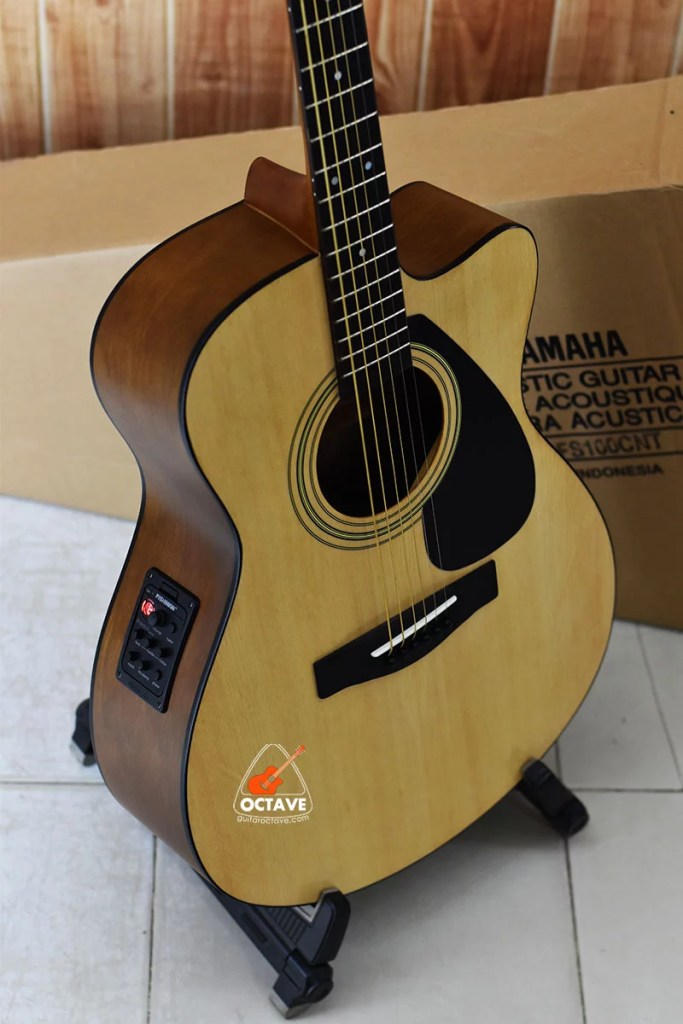
Electro-acoustic guitars are acoustic guitars that have a ‘pick-up’ (basically, a microphone) built into them so they can be plugged into an amplifier or a PA system.
This is a way of ‘connecting’ an acoustic guitar up to an amp to make it louder.

Semi-acoustic guitars (sometimes also called ‘hollow bodied electric guitars’) occupy something of a middle-ground between acoustic guitars and electric guitars.
They’re thin and compact like electric guitars, but have hollow bodies like acoustic guitars. Because they’re thin and compact, they won’t produce quite as loud a sound when unplugged as an acoustic will, hence the term: semi-acoustic.
Some notable models of semi-acoustic are the Gibson ES-335 and the Fender Telecaster Thinline.
(basically a semi-acoustic telecaster)

Unlike the previous guitars, these guitars have solid bodies and as such, produce very little in the way of sound unless they’re plugged into an amplifier.
If you want to play electric guitar you will need an amp. Electric guitars come in a variety of shapes and sizes. Some of the most iconic are: the Gibson Les Paul, the Fender Stratocaster and the Fender Telecaster.
Like the acoustic guitar, electric guitars are usually made of wood and usually have six strings, though there are twelve string versions available.

Once upon a time, being the bass player in a band meant lugging a huge double-bass as seen in orchestras and jazz bands to and from practice.Thankfully, the good folks at Fender eventually came out with a guitar version of the bass that, among other things was a lot more portable than its predecessor.Unlike regular guitars, bass guitars usually only have four strings, and they’re big, thick strings that produce a big, thick sound.
Electrics are not as good for more traditional types of music such as folk. Many folk venues don’t use any electronic amplification whatsoever.(Not even a PA!)
Types Of Guitars #6 – Cousins Of The Guitar
Fun fact: The guitar is a descendant of the lute. There’s a number of other instruments that have sprung from the lute family as well. Think of these as ‘distant cousins’ of the guitar. These aren’t really types of guitar, but similar stringed instruments.
The Mandolin :
Mandolins are a bit like strummed violins, in that they are tuned the same way, albeit with double the number of stings, but they are strummed like guitars rather than played with a bow. They have a very bright, trebly sound and are popular in styles of music like folk.
The Banjo :
Banjos have five strings that are usually tuned to an open G chord. Instead of having a soundhole like a guitar, a banjo has a drum for a body.Banjos are all treble and no bass, giving them a very twangy top heavy sound. They’re very popular in styles of music such as folk, bluegrass and country.
The Ukulele :
Ukuleles are small Hawaiian instruments with four strings that look a lot like miniature guitars. Like the mandolin and the banjo, a uke produces a very trebly, delicate, ‘twinkly’ sound.
They’re ideal for people who want to play and or write songs, but find guitars to be a bit big for them.
Ukes are popular in traditional Hawaiian music. There’s also been something of a craze of ukuleles at open mic. nights and on Youtube over the last few years!
This is a seven string guitar. It might be one of the coolest types of guitar of all!
Seven string guitars have an extra low string, usually tuned to a B.
They were pioneered by speed metal guitarist Steve Vai and have become quite popular with metal guitarists looking for that ultra low, heavy sound!
This is a double-necked guitar, being played by Jimmy Page of Led Zeppelin.
This particular model has one 12-string neck and one six-string neck, though you also sometimes see double-necked guitars that are a bass and a six-string. (Which makes them one of the most versatile types of guitar of all.)
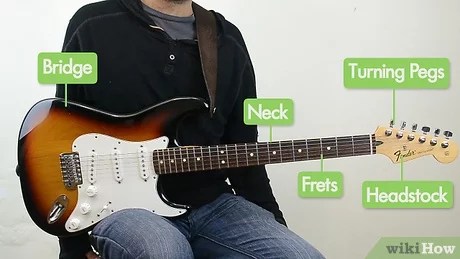
Identify the parts of the guitar. Whether you’re playing an electric or an acoustic guitar, the instrument is essentially wood and metal. Copper-wound strings vibrate to create sound. The wooden body resonates that sound to create the warm tones we associate with a guitar.[1]The strings run between the headstock of the guitar, where they are affixed to tuning pegs that can be rotated to tighten and slacken them, and the bridge, where they’re fixed to the guitar’s body. On an acoustic guitar, the strings are fixed to the bridge with removable pegs, and on an electric guitar the strings are generally strung through an eyelet.
The neck of the guitar is the long wooden piece of wood, flat on one side (this is called the fretboard) and curved on the other. The fretboard is inlaid with metal frets that demarcate the different notes.
An acoustic guitar will have a sound hole in the body where the sound will resonate, while an electric guitar will have as many as three magnetic pickups which will channel the sound through an amplifier.

 Soumya Strings Academy
Very good
LikeLiked by 1 person